
Image
  • Boston cityscape. Bert Kaufmann, Roermond, Netherlands. CC BY 2.0 (http://creativecommons.org/licenses/by/2.0), via Wikimedia Commons

  • Case Study

    Coastal Resilience Job Training: Climate, Housing, and Economic Development

    The City of Boston’s Office of Workforce Development is leading a large-scale collaborative initiative to develop and implement a Climate Ready Workforce Action Plan that will help meet the objectives of approved City and state-level climate action and coastal resilience plans while also addressing economic and housing development goals.

    Image
    NOAA Research logo
    Location Boston, MA
    Year
    2025
    Cost $9.8 million

    The City of Boston Office of Workforce Development (OWD) is conducting a formal Workforce Needs Assessment to help meet coastal resilience, climate action, and economic development goals. City staff estimate that more than 160,000 workers in 45 different occupations will be needed in the next quarter century to design, implement, and advance the City’s economic ambitions associated with environmental goals. These estimates include both new hires and existing workers in occupations that focus on resilience and sustainability. 

    State and municipal agencies, large construction firms, and small businesses have committed to hire 1,277 entry-level workers to begin addressing those needs. Roughly 500 of these new jobs will be in the construction trades and other skilled trades. Job training and hiring for these positions take place in support of a project labor agreement for state and civic projects that was signed by the Greater Boston Building Trades Unions and the North Atlantic States Regional Council of Carpenters. Trade union apprenticeship programs will provide the necessary training for these jobs with a focus on energy efficiency, renewable energy, electric transportation, electric infrastructure, and maintenance. 

    Community, trade, and technical colleges will adapt curricula to address energy efficiency, renewable energy, and electric transportation to advance job skills and capabilities of new, needed workers. As part of this vocational training effort, the top-performing half of the graduating classes from each of six programs at Madison Park Technical Vocational High School––up to 50 students per year––will receive guaranteed admission to preapprenticeship and registered apprenticeship programs.

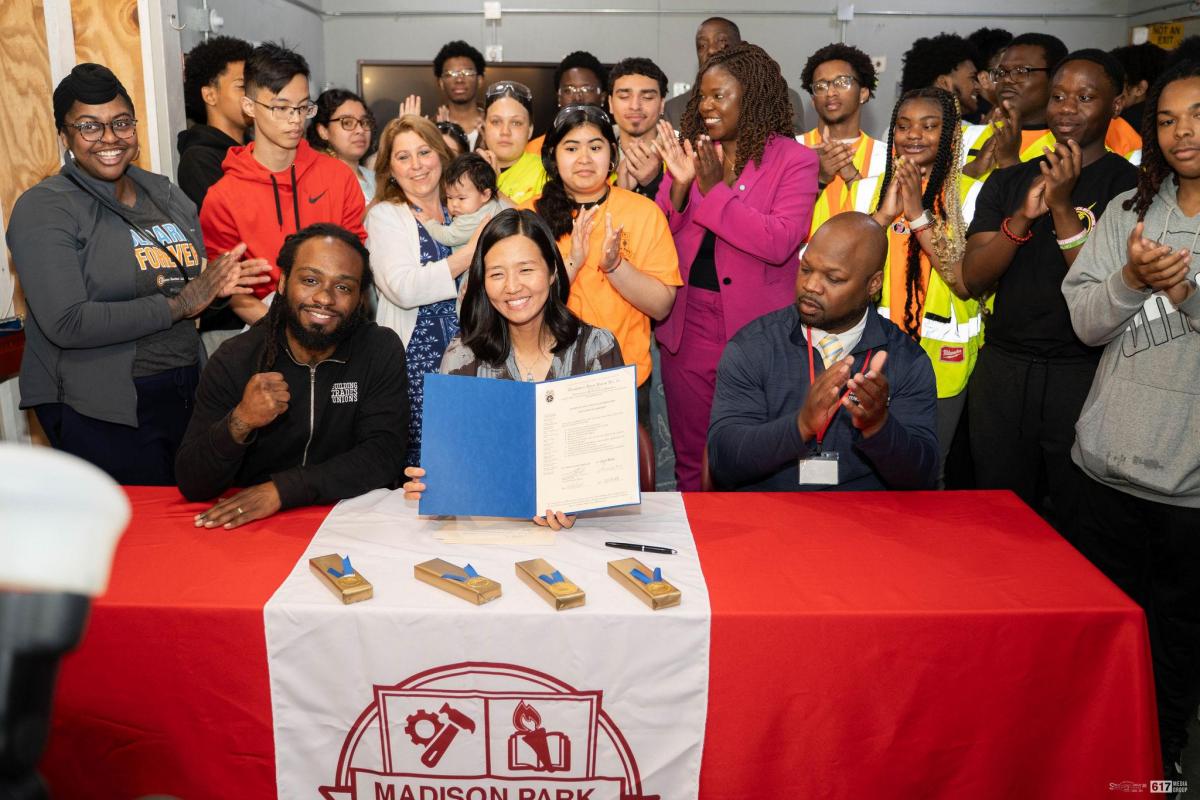
    Image
    A group of people gathered around a table celebrating as a woman holds up a signed document, smiling. The table is draped with a red cloth featuring the "Madison Park" logo. Some attendees are clapping and cheering in the background.

    Mayor Wu and students at Madison Park Technical Vocational High School are celebrating new career opportunities for Boston's youth.

    Outside of the construction trades, the OWD is focusing resources on training 645 people for entry-level and non-BA career pathways in skilled trades that address coastal resilience through green infrastructure, urban forestry, projects to elevate parks, and water and wastewater systems. Based on historical completion rates, the OWD estimates that these training programs will lead to 485 new hires in stormwater management, installation and adaptation of green infrastructure, managing the City’s tree canopy, and landscape maintenance. The City of Boston, State of Massachusetts, and small business landscape contractors have committed to hiring these coastal resilience trainees. 
    To coordinate and lead this initiative, the OWD created the Greater Boston Coastal Resilience Alliance, which comprises public and private sector employers, trainers, childcare and other support service providers, community outreach and recruitment partners, labor unions, and climate experts. 

    Under these construction and coastal resilience training initiatives, the OWD is creating family-sustaining, entry-level skilled labor jobs that provide salaries, benefits, and pathways for advancement. Early indications suggest that these initiatives are catalyzing collaborative thinking across other departments and organizations to support similar efforts that will address the wider range of workforce skills needed to fulfill the City’s Climate Ready Workforce Action Plan.
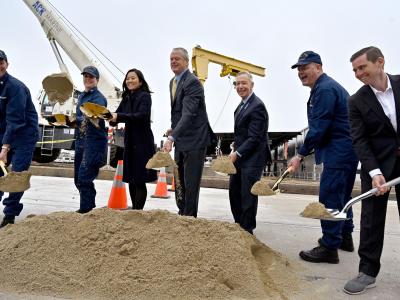
    Image
    A group of people in work uniforms and suits are participating in a groundbreaking ceremony, each holding a shovel with sand. They are standing around a pile of sand with construction equipment visible in the background.

    Mayor Wu, Governor Baker, and Coast Guard leadership kick off a major waterfront infrastructure project in Boston's North End.

    Boston faces increased frequency and intensity of heat waves and extreme precipitation. With 47 miles of coastline, the City is also exposed to overland flooding and inundation from storm surge. The City’s climate action and coastal resilience plans call for adaptation in anticipation of 40 inches of sea level rise by 2070, which would exacerbate coastal and river flood damage valued at $1.4 billion.

    To mitigate these potential impacts, Boston’s adaptation plans call for substantial investments in nature-based solutions, green infrastructure, urban forestry, flood management infrastructure, infrastructure maintenance, and other measures. These investments are part of a comprehensive Climate Action Plan that also includes a $2 billion overhaul of school facilities, $50 million for updates to public housing units, and $30 million to electrify the City’s vehicle fleet, including vehicle charging stations.

    The OWD successfully met its main project goals by securing partnership commitments and beginning planning and design processes. Through a needs assessment and other initiatives, the OWD has identified several challenges that the coastal resilience workforce initiative can help address. Trade unions and the workforce development and educational departments of Boston’s community and technical colleges currently offer sustainability-related certificate programs in: energy efficiency; solar energy; building management and maintenance; construction materials and processes; and electric transportation. Improving coastal resilience will require additional knowledge and new skills. Recognizing the significance of this need, the OWD is bringing coastal resilience, stormwater management, nature-based solutions, and water and wastewater operations into Boston’s education and training pipelines.

    Training programs do not always provide the soft skills and teamwork skills that employers are looking for, so OWD is supporting training in these areas as well. Many employers have identified those skills as critical for hiring and career advancement. 

    Because young people are not getting driver’s licenses at the same rate as previous generations, one training partner is organizing pre-training to help students earn learners permits for commercial driver’s licenses as part of its job training initiative. The OWD is also piloting drivers education training programs of its own.

    As part of the City’s wider economic development mission, the OWD is recruiting trainees in underemployed communities and implementing English as a second language programs, childcare programs, stipends, and “earn to learn” opportunities for trainees.

    The high cost of housing has encouraged a trend in which employees with good jobs migrate to more affordable suburbs, thereby undermining economic development efforts within the communities they once lived in. To meet this challenge, the City is working to create additional affordable housing and mixed-use occupancy opportunities throughout Boston as part of its Anti-Displacement Action Plan.

    Title
    Funding & Building Capacity
    Text

    The OWD received a $9.8 million Climate Ready Workforce grant from NOAA to develop and implement the coastal resilience workforce development program. This initiative operates within Boston’s larger Climate Ready Workforce Action Plan and is integrated with multiple other plans, partnerships, construction labor agreements, goals for workforce diversity and local hiring, and other programs.