Image
  • Aisling Kerr

  • Case Study

    Meeting Employer Needs through a Three-Tiered Approach to Curriculum Design

    The Ohio State University is collaborating with employers, non-profits, Historically Black Colleges and Universities, and community and technical colleges to redesign curricula for career pathways in the skilled trades, middle management, and technical professions related to water resources management.

    Location Coastal Ohio
    Year
    2025
    Cost $4.8 million

    Image
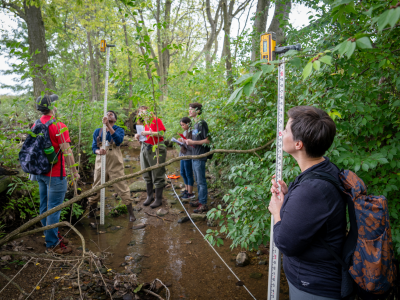
    Several students and an instructor conduct stream surveying in a dense, wooded forest.

    Graduate students engage in stream restoration training, using survey equipment to measure and assess a wooded stream area. Graduate students Jalen Smith and Alessandra Bertucci are capturing signals from a laser level as part of their Stream Geomorphology and Watershed Hydrology training. 

    A team of educators at The Ohio State University (OSU) is leading a collaborative initiative involving Historically Black Colleges and Universities (HBCUs) and community colleges to provide training in the skills needed to help Lake Erie coastal communities become more resilient to flooding, ecosystem loss, and freshwater contamination due to algal blooms. The team is adapting existing curricula and creating new training programs focused on increasing workforce competence in the climate resilience measures that regional employers are looking for.

    Specifically, an initial employer survey revealed a need for trained environmental experts in wetland ecosystems, plant and aquatic species taxonomy, stormwater infrastructure management, Geographic Information Systems (GIS), and data analytics to manage coastal resources along Lake Erie. To begin addressing these needs and create good job opportunities quickly, the team is implementing some training initiatives concurrently with completing market assessments and curriculum design.

    Modules on intercultural competency, computer literacy, and basic climate knowledge, for example, have been added into certification workshops and other educational offerings. During the summer of 2025, pre-certification workshops on basic computing and climate knowledge augmented a two-day certification program on Maintenance and Inspection of Stormwater Control Measures. The combined program was co-produced by the Summit Soil Water Conservation District and OSU, with wraparound services, such as childcare and transportation, offered to 35 trainees.
    Image
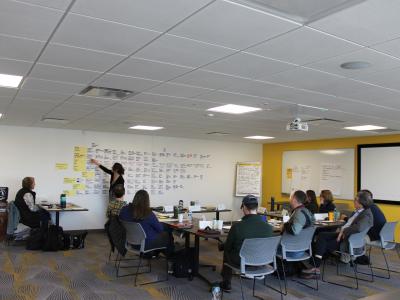
    A group of students in a classroom looking toward someone presenting at the front of the room

    A team of experienced OSU facilitators from the Center on Education and Training for Employment conducted the workshop. 

    Project leaders are working to design a three-tiered approach to workforce development training in which each tier targets a different level of vocational and higher education. 

    1. The first tier involves two-week workshops that will focus on specific skills, certifications, and micro-certifications. These workshops will emphasize on-the-job training for both current employees and prospective new employees of municipal water districts and contractors. Recruiting is supported by the team’s community and training partners, including the Junction Coalition, the Student Conservation Association, Northeast Ohio Regional Sewage District, and Central State University.
    2. The second tier involves reworking the two-year curricula at community colleges in response to employer needs. Early input from employers to Ohio Technet, which is an organization working at the intersection of education and employment, suggests that focusing curricula on data analytics, hydrology, water quality, and finance will support good, career-oriented jobs that can improve coastal resilience. The collaborative education team plans to redesign community college majors and programs accordingly.
    3. The third tier involves integrating robust GIS education into the College of Engineering and College of Food, Agriculture, and Environmental Sciences graduate programs at OSU. An initial six-week fellowship program launched this effort for current students in the summer of 2025.


    Lake Erie is the warmest and shallowest of the Great Lakes and, as a result, is the most susceptible to harmful algae blooms that impact ecosystems and water quality. Additionally, Cleveland, Toledo, Sandusky, and numerous smaller communities located along the Lake Erie shoreline are susceptible to flooding events.

    Educators recognize that implementing resilience measures requires a wide spectrum of trade, management, and professional skills, so they are adapting programs at multiple levels of vocational and higher education to support job opportunities in the region. Existing curricula are being adjusted and new curricula are being created by the project's diverse team of educators to provide students with the necessary knowledge and skills.

    Training programs successfully launched in the summer of 2025 to address gaps in vocational and graduate school curricula. An employer survey, employer and partner convenings, curriculum planning, and design are ongoing for all three educational tiers.

    Project organizers plan to share their methodology and results across higher education and technical education communities to support initiatives that can address local concerns and opportunities in other regions.

    Title
    Funding & Building Capacity
    Text

    The Ohio State University received a $4.8 million Climate Ready Workforce grant from NOAA to support this work.

    Relevant Options