
Image
Case Study

A Trade Association Initiative Is Expanding Critical Workforce Skills in Multiple States

The Flood Mitigation Industry Association is addressing an urgent shortage of workers skilled in elevating buildings above flood levels and sealing buildings that cannot be elevated by creating training programs for entry-level jobs in good-paying, high-demand careers.

Image
NOAA Research logo
Location Coastal Louisiana
Year
2025
Cost $7 million

Elevating residential and non-residential structures above high-water flood levels and “dry floodproofing” (i.e., sealing and protecting) structures that cannot be elevated are effective ways to minimize flood damage and maintain the value of these assets. On average, one dollar spent on these measures saves six dollars in disaster recovery costs while preserving community life and economic vitality.

The knowledge and skills required to elevate and dry floodproof structures is primarily held by family-owned small business contractors who train each new employee through on-the-job mentorship. Lifting structures is physically demanding work that also requires a safety-oriented mentality and a capacity to remain attentive and focused. Given these factors, only a small percentage of new hires work out. While effective, the one-on-one approach to job training is labor intensive and inefficient for contractors and insufficient to protect a growing number of property owners, tenants, and communities that are threatened by rising sea levels and increasingly severe coastal and riverine storms.

The Flood Mitigation Industry Association (FMIA), a trade association that was created to address the growing flood risk challenge, began a workforce development initiative in 2024 to scale-up skills training for good paying, career-oriented, entry-level jobs in the flood mitigation industry. FIMA is headquartered in Coastal Louisiana, where the highest concentration of experienced contractors reside. There, FMIA is working with SOWELA Technical Community College to create training and educational curricula in structural elevation and dry floodproofing that will be taught by industry professionals. Over time, FMIA plans to increase the industry’s capacity by implementing a train-the-trainers strategy so that community college faculty, trade unions, and independent professional trainers can expand the training pipeline in multiple regions.

Image
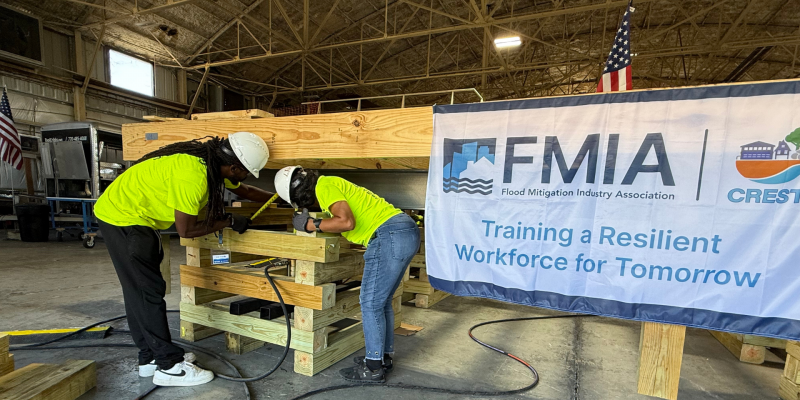
Two people reach into a wooden structure with beside a FMIA banner
  • Roderick Scott, Climate Resilience Skills Training (CREST)/Flood Mitigation Industry Association (FMIA)

  • Description

    Training a resilient workforce for tomorrow with the FMIA Flood Mitigation Industry Association and CREST.

    Image
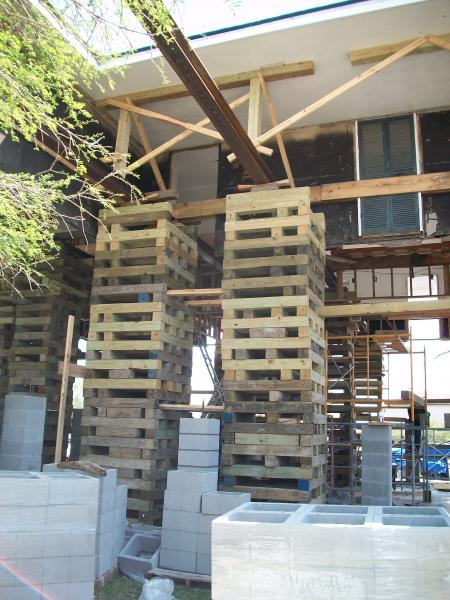
    A construction site with wooden pallets stacked to support a building structure, surrounded by cinder blocks and scaffolding.

    A structure in Louisiana undergoes elevation using steel beams and wooden cribbing towers, a critical flood mitigation technique.

    FMIA is working with FEMA and the U.S. Army Corps of Engineers (USACE) to deploy a pilot training program in Calcasieu Parish, Louisiana, where federal investments will support structural elevation of buildings in historically underemployed and under-resourced communities. FMIA is collaborating with KEI Marketing, an established human resources organization that is trusted in these communities, to support recruiting efforts and provide wraparound services for trainees.

    Through this collaboration, FMIA plans to train entry-level workers in Louisiana for jobs with salaries ranging from $48,000–$60,000 and which offer defined career pathways. These jobs will initially be supported by federally funded building elevation projects, yet the demand for front-line flood mitigation services is so extensive that FMIA hopes to foster multi-generational participation in what is fast becoming a critical industry.

    Reaching beyond Louisiana, the FMIA’s goal is to create training programs that can be adopted throughout the country and around the world to help coastal and riverbank communities adapt to the growing risk of flooding. The organization is marketing its training program in other high flood risk regions. While the critical knowledge and skills are transferable between regions, the delivery channels for worker training are likely to vary. In New York, for example, where the skilled trades are unionized, labor union apprenticeship programs might augment or replace community college offerings.

    Image
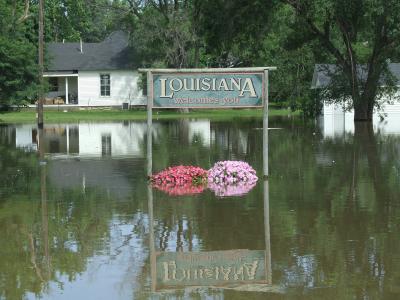
    "Louisiana Welcomes You" sign nearly submerged in floodwater

    "Louisiana Welcomes You" sign on S. 3rd Street now stands in Mississippi flood water.

    Storm surge, intense precipitation, and flooding events are recurring risks in a growing number of shoreline areas, especially in places where subsidence is also taking place. Portions of the U.S. Gulf Coast and East Coast, as well as riverine areas, are particularly vulnerable to recurring flood disasters. 

    The risks are both widespread and substantial. Banks have told the flood mitigation industry that in 20 years’ time, older high-flood-risk buildings that have not been elevated or dry floodproofed could devalue by as much as 40%. The USACE, meanwhile, has told the industry to be ready to elevate or dry floodproof 250,000 structures by 2035. Three-quarters of these are residential buildings. The U.S. Army Corps of Engineers has more than a dozen flood mitigation mega projects at various stages of planning and implementation. Among these are three projects in Louisiana, another in Virginia, and one in New York that have received funding levels sufficient to elevate roughly 6,000 structures. 

    Structures are backbone assets for families, businesses, and communities, so the consequences of substantial devaluation or damage would be far-reaching for people, employers, and entire communities. By securing structures against flood damage, communities can recover from extreme events with minimal damage and disruption while maintaining the tax base and economic vitality that are necessary to support adaptation of community assets and infrastructure, implement nature-based solutions, and plan for longer-term resilience.

    Recognizing the wide gap between the near-term need for skilled workers and today’s one-at-a-time approach to qualifying and training new hires, FMIA and its educational and community development partners are creating new training programs that will rapidly expand capacity and shorten the training-to-full-employment timeframe.

    FMIA initiated entry level training for structural elevation and dry floodproofing jobs in the fall of 2025. Initial training activities were designed for relatively small numbers of students (10-12) in order to facilitate hands-on instruction by industry professionals. By keeping employers engaged with small numbers of trainees, both employers and students are able to determine who is well suited to careers in the field.

    Title
    Funding & Building Capacity
    Text

    FMIA received a $7 million Climate Ready Workforce grant from NOAA to develop the Louisiana pilot program. Once established, FMIA believes the training curriculum will be supported by employers and the regional community college system. Meanwhile, FMIA is also building relationships in Long Island, Virginia, and elsewhere to identify pathways for sharing the Louisiana curriculum in other regions.

    Read more

    Elevating structures and other civic assets requires substantial upfront investment. In Louisiana, the cost to elevate a structure is roughly $120 per square foot. In Long Island, the cost is closer to $200 per square foot. The buildings to be elevated in underserved communities of Calcasieu Parish, Louisiana, will be funded by a USACE project. Job trainees will be recruited from within these same communities.

    Future USACE projects that are already in the development pipeline are intended to fund the elevation or dry floodproofing of additional structures over time. Given the scale of need, however, multiple funding mechanisms are likely to be needed. In neighboring Mandeville, Louisiana, for example, 700+ structures along a 60-block waterfront have already been elevated. In this relatively affluent community, 80% of the work was funded by individual property owners. Thinking about funding more broadly, the FIMA is working with the banking industry and elected officials to create a revolving loan program with on-mortgage repayment so that more property owners can finance the protection of their own assets.